Design: going beyond expensive sofas
In my classes, I always make a distinction for my students between three concepts: craft, art, and design. A craftsperson makes an object by hand, one at a time, with the intention that someone will use it. An artist also produces something unique, but without it having to be functional. You don't make art because it matches the colour of the wallpaper. A contemporary designer moves somewhere between the two, as a hybrid of artist and craftsperson.
A product designer designs a functional object to be manufactured as part of a series. It has to be reproducible. The word design is therefore linked to the Industrial Revolution, because before then a creation could only be craft or art. Today, those strict distinctions no longer really apply, but I still think it makes sense to use design simply to mean something with a form that has been carefully considered. In itself, then, the word implies no judgement of quality. A BIC ballpoint pen is design, a Bauhaus chair is design, and an IKEA cabinet is design too. All these things were designed to be used, and were reproduced industrially. There you have it.
But something strange happened in the 1980s, particularly here in Flanders. We started using the word design as a value judgement. What looks distinctive and daring? Who are the big names? It became all about the icons. That was when the word changed both its character and its meaning. Design became something we had to bring into our homes to prove that we had good taste.
Strangely enough, this led us to start calling useless objects design. Remember that juicer by Philippe Starck? It stood on tall legs, a bit like a rocket or a spider, and you had to put your glass underneath it. It was anything but practical, and, what's more, the metal could not withstand lemon juice. Pretty absurd, but we still left the useless thing prominently displayed on the kitchen worktop. The modernists used to say ‘form follows function’ about their designs, but for the Starcks and Alessis of this world, it was ‘form follows fiction’.
In the Netherlands, a strong counter-movement emerged after the 2008 financial crisis. Good designers were fed up with being sucked into marketing machines, and used primarily to entice consumers. That was when social design really took off at the design academy in Eindhoven. Designers no longer wanted to add more products to the world. There were enough chairs already. What they did want to do was to address social issues.
For her graduation project, Christien Meindertsma created the book PIG 05049. It's a hefty book, with each page featuring an object derived from some part of a pig. She followed the by-products all the way to the factory and catalogued what was made from them: sweets, cosmetics, biodiesel, heart valves, a bullet… It was a real eye-opener. The movement has grown enormously in the Netherlands, with designers questioning or redirecting the production process rather than simply producing more things.
Ghent is no different. Here too, designers have embraced socially responsible and restorative design. There are plenty of examples, but I'll limit myself to three.
First, there is the ONBETAALBAAR collective. They work according to circular principles. For every material they use, they want to know where it comes from and where it can go afterwards. They chose their name, which means ‘unaffordable’, as a reaction against trendy design that was unaffordable in practice. Now that they have grown into a larger design practice, they want to prove that circular design can also be profitable. They do everything themselves, from design to joinery, welding, and installation. True all-round designers, in other words. They designed the café at Music centre De Bijloke, the coworking space at Time lab, and the Astroboy restaurant, among others.
CAMPUSatelier is another interesting collective. Their work is more closely related to urban planning. In ‘challenging’ neighbourhoods such as Nieuw-Gent, they work with local residents to create public furniture and amenities: benches, a pavilion in the park, seating for an open-air cinema, and so on. What matters most to them is that the decisions are not made by a single designer. The people who will ultimately use these objects are also the people who conceive and make them. It's something I also encountered in my own research: when people make something themselves to meet a need of their own, they don't call it design, yet these are precisely the objects they cherish.
Manoeuvre, on the other hand, starts from craft. For example, they work with Turkish-Ghent women on a tapestry, using weaving techniques that are no longer passed down here, but which are now attracting renewed interest. The last project of theirs I saw involved embroidering a large plastic bag, inspired by Ursula Le Guin’s Carrier Bag Theory of Fiction. It wasn't necessary to understand the theory behind it; the event itself was what really mattered. They describe what they do as relational design. For me, one result of that was going home with a pair of handmade slippers.
Does that mean design has to save the world? No, that's not going to happen. What it should be capable of doing, however, is changing attitudes. Asking questions. The new Design Museum Gent will undoubtedly help with this. It starts with the building itself, with the Gent Waste Brick that BC Architects developed for the museum from waste materials. Unfold, the collective that designed the large entrance gate, also developed an open-source 3D printer for ceramics.
In any case, I see a lot of potential at the intersection of science and design. Scientists carry out groundbreaking research, but they don't always find a way to reach the public. Bring in someone with an artistic practice, and the whole narrative changes. Take the polluting pigment industry, for example. The biolab at KASK School of Arts has been working on this very issue. Recently, they began developing ‘structural’ colours of the kind found in butterflies and peacock feathers. You're unlikely to see the result at H&M any time soon, but you might see it in an exhibition that makes people sit up and take notice. And eventually, perhaps they will be the ones asking H&M the questions.
Discover more at Design Museum Gent.
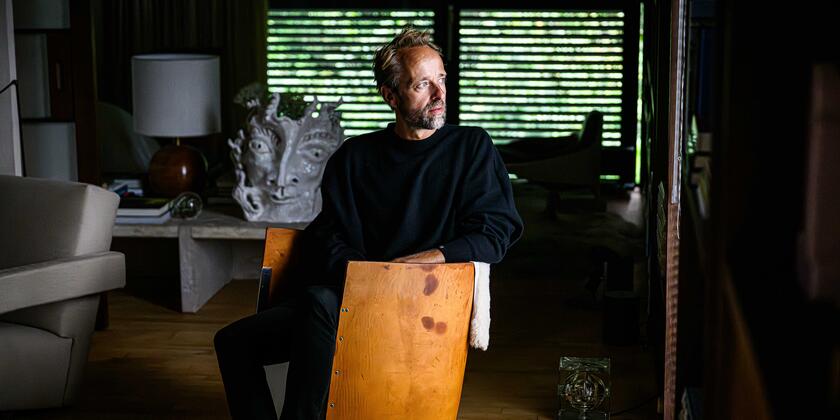
Hilde Bouchez is an art historian, anthropologist, and professor of design history at KASK Gent and KU Leuven. In her book Het Wilde Ding (The Wild Thing), accompanied by an exhibition at Design Museum Gent, she explored new meanings for design.