The pimples of Joos Vijd
Elisabeth Borluut and Joos Vijd may not be the best-looking people. She has hard features and looks sternly into the distance. He seems to raise his eyebrows haughtily. The corners of his mouth are turned downward, his cheeks are hollow and every pimple and wrinkle is visible in his slightly bloated face. This has led some amateur art historians to attribute all sorts of character traits to Joos Vijd.
Perhaps Van Eyck wanted to convey a message about Joos Vijd’s vanity, hypocrisy or sinfulness? All blatant nonsense.
First, some facts. Joos Vijd’s father was the bailiff of Beveren, but he lost that position when Duke Philip the Good sacked him for committing fraud. His son Joos had to regain the family’s fortune as a peat trader in the Waasland region. And he succeeded, as he became an alderman in Ghent and eventually held an office comparable to that of mayor.
In a way, as a member of the gentry, he was a nouveau riche — certainly in comparison with his wife Elisabeth, who came from the Ghent patrician Borluut family. As their marriage was childless, the house of Vijd came to an end with their deaths.
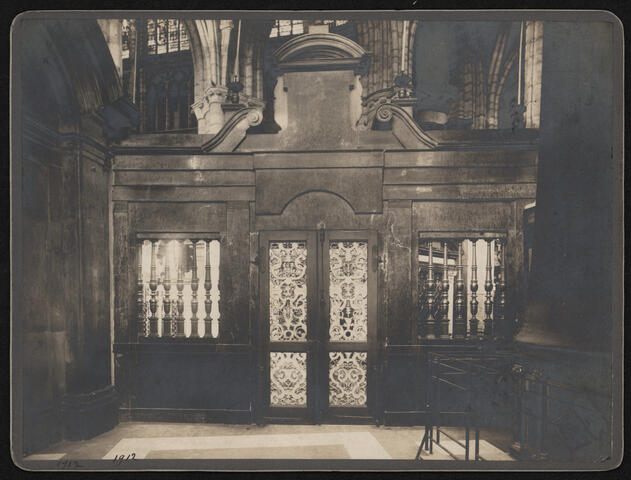
It is remarkable, even for that pious time, how much the couple invested in St John's Church (currently St Bavo's Cathedral). They paid a fortune for a part of the church, for their own chapel and the unprecedentedly ambitious Ghent Altarpiece. For some, the reason was obvious: Joos Vijd had to redeem his sins and paid all that money to ensure his spiritual welfare. Just look at the purse which Van Eyck painted on his belt: doesn’t it make clear that we’re dealing with a hypocritical capitalist?
As the aristocratic lineage ended with the childless couple, this work of art was a good way to keep the name Vijd alive. And they succeeded marvellously, because we still talk about them today.
This tale of penance is totally baseless. Perhaps this man had indeed enriched himself at the expense of others, but that was to be expected and the portrait by Van Eyck does not tell us anything about this. It is impossible to infer anything about the life or character of Joos Vijd and Elisabeth Borluut from the Ghent Altarpiece, except that they commissioned the painting.
The couple had at least two reasons for commissioning the painting. The first one was devotional: pure piety. The second reason was social prestige: showing off how important they were. We consider the former noble and the latter vain, but they were perfectly compatible in the 15th century. As the aristocratic lineage ended with the childless couple, this work of art was a good way to keep the name Vijd alive. And they succeeded marvellously, because we still talk about them today.
It is certainly true that Jan Van Eyck didn't paint a nicer picture of his patrons than they actually were. Nowadays, we tend to draw conclusions from that fact. If we want to show someone in the best possible light, we will look for the best angle or Instagram filter to gloss over any imperfections. That would also have been possible back then. Vanity is of all times and some painters certainly depicted their rulers and leaders in the most flattering way. But Jan Van Eyck did not.
His artistic approach required him to portray his subjects in the greatest possible detail. Van Eyck’s motto was “als ich can”. This can be translated in a modest way as “I’m trying my best”, but also more ambitiously as “I’m doing all I can to come close to perfection”. And that was his goal. Jan Van Eyck intended to depict God’s creation as faithfully as possible, in order to come closer to the divine. In medieval treatises, this was called Visio Dei: the vision of God.
That’s why all the plants in the Ghent Altarpiece were painted true to nature. That’s why Van Eyck studied splashing droplets in extreme detail and painted them optically correct in the fountain. That’s why the texture and the embroidery of the clothes and the reflection of light in each one of the hundreds of pearls are exactly right. And that’s why he painted Joos Vijd as he posed for him in 1432, warts and all. To perfectly capture creation, even with its imperfections.
Jan Dumolyn is professor of medieval history at Ghent University. As co-curator of Van Eyck — An optical revolution he re-examined the historical sources relating to the Van Eyck brothers. That was high time, because (too) many myths and half truths about the Ghent Altarpiece are endlessly repeated.