Life as it is: the conservation of The Ghent Altarpiece
Your studio is in the Museum of Fine Arts – isn't that stressful?
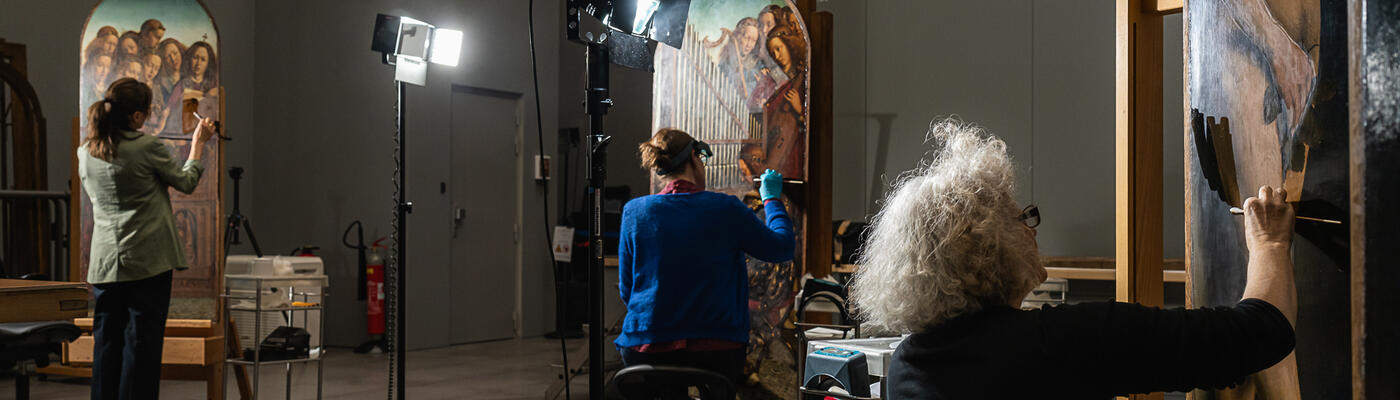
It’s true thatpeople can actually see us at work through the window. But we're used to that. We don't hear them anyway, because the glass is soundproof. It is also quite dark in that visitors' room, so we don't see the visitors as clearly as they see us. Sometimes, there is a group of children who dare to knock on the window, but people mostly show a lot of respect. Every month, we also hold a session at the museum where members of the public come along to ask questions and we get a tremendously positive response there.
How long has the team been working on this?
The initial research, including extensive scientific imaging and drawing up a plan of action got underway back in 2010. The actual conservation treatment began with the outer panels, from 2012 to 2016. We then tackled the bottom register of the interior, from 2016 to 2019. A long hiatus then followed, due in part to the coronavirus crisis, which means we have now been working on the upper register since May 2023. This register consists of the Virgin, the Deity, St. John the Baptist, the singing and music-making angels, and Adam and Eve. The target date for completion is 2027.
How many of you are there?
At the moment, we are working as a group of eight. Each one of us has between 10 and 30 years of experience and we are a close-knit team. Each person works primarily on his or her ‘own’ panel – for example, I myself am now working on the panel of John the Baptist – but we also sometimes work on the other panels and discuss a lot among ourselves. That's how you can keep learning from each other. In fact, we never run out of things to talk about. The conversation about The Ghent Altarpiece often simply continues during lunch.
How much can you complete each day?
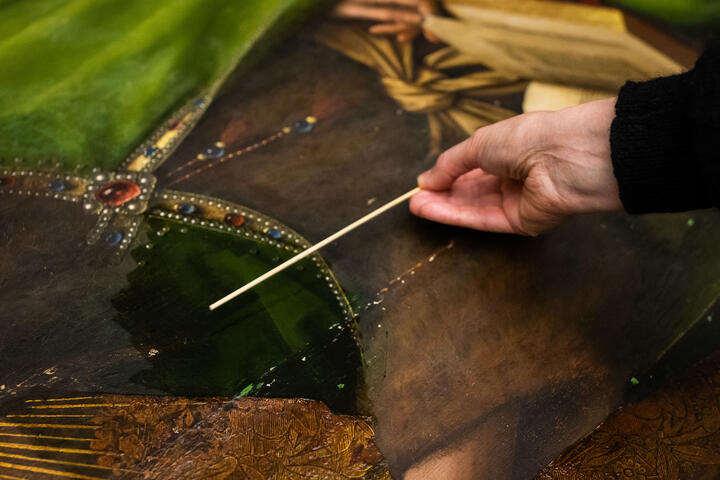
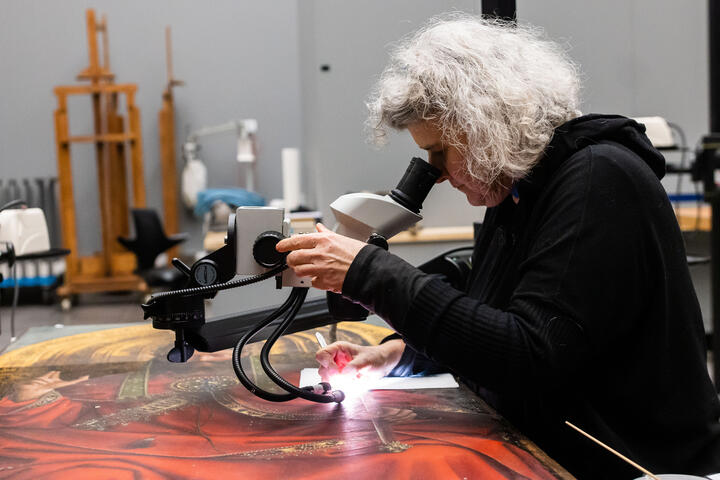
At the moment, we're busy removing the old, sixteenth-century overpainting. This is done very precisely with a surgical scalpel under the stereo microscope. It depends a bit on the area we are working on, but a reliable estimate would be no more than sixteen square centimetres per day, sometimes even less.
Another factor that also comes into play is the type of paint used in the overpainting and the condition of the underlying layers. For example, on the red robe of the Deity , there are now always two of us working at the same time. That monumentally large surface has been completely overpainted and the underlying layers of original paint with beautiful deep red shadows are showing some local wear, so we need to take even more time for that area.
Do you work with a magnifying glass?
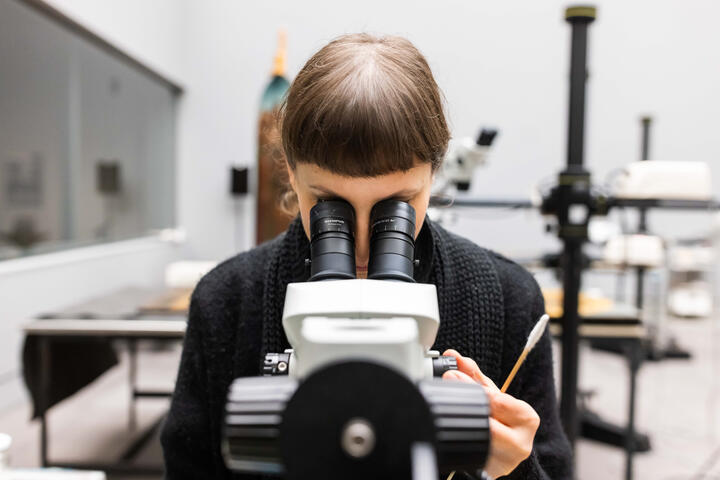
We alternate between a microscope and special pair of glasses, depending on the work. When examining the paint layers and removing overpainti, we always use the microscope, which magnifies images up to forty times. When removing varnish, we usually use glasses. They only provide three times magnification, which makes it easier to maintain a better overview. Filling and retouching are therefore usually carried out while wearing glasses, but when filling in very small losses, we sometimes do actually use the microscope.
Do you have the radio on?
No, there's no radio. Some of us do listen to music or a podcast through headphones. I prefer absolute silence myself.
When we removed the discoloured varnish from Adam's head, I really felt that we were seeing a flesh-and-blood human being appear before us.
How long do you continue working at a stretch?
Sometimes we don't take enough breaks. When you are working, you lose your sense of time. Doing this type of work means that you're completely immersed in it. My physiotherapist says I would be better off stopping for a short while every hour, but you gradually build up the knack. If you take a break, it takes a while to get the flow back again. Some of my colleagues come to work in the morning, settle down and are still in the same position in the evening.
How do you decide which layers need to be removed?
We don't make the final decisions ourselves. An international committee of 22 experts is monitoring following everything. The committee is made up of art historians, conservators and chemists, all of whom are Van Eyck experts or have a detailed knowledge of 15th-century painting. They join us at all important moments and, based on our findings, they give advice that we discuss with the Belgian committee. I'll spare you the details about the many steering committees and decision-making bodies, but the most important thing to remember is that nothing we do here is left to our personal taste.
The goal of the conservation is to remove the old, sixteenth-century overpainting and to reveal, as much as possible, the original layers that were painted by the Van Eyck brothers. But a paint layer will only be removed if there is conclusive evidence that it is an overpaint. And it must also be possible to remove it without damaging the original.
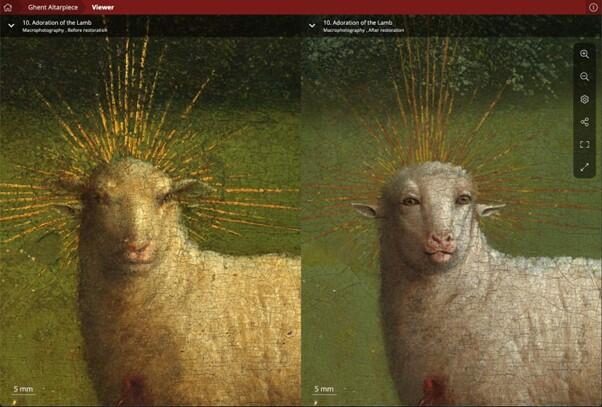
There was a lot of controversy about the face of the lamb. Is the version we can see today definitely the original one?
Absolutely. We treated the lamb in exactly the same way as the rest of the paintings. For example, we saw that cracks in the head of the original lamb had been overpainted. Those typical cracks in oil paint, which are known as ageing craquelure, only occur after a long time, so we knew for sure that the added layer of paint was an overpaint. All the other research findings pointed in the same direction.
Of course, this part of the conservation generated many more responses, because the difference between the ‘new’ lamb and the ‘old’ one is so noticeable. No-one will shout as loudly if a fold in an area of drapery looks different and of course that's understandable. But the decisions are always made on the same scientific basis, that is, after carrying out analyses, scientific imaging, and observations under the microscope.
And why was the lamb overpainted? Do we know?
That's hard to say, of course. The repainted lamb had eyes on the side of its head, while in the original they are located more towards the front. Some people now take the view that its gaze is more human now. In this altarpiece, the lamb off course also symbolises Christ. However, we can say with certainty that we recognise Jan Van Eyck's brushwork and realism in the original lamb. Just look, for example, at the horizontal pupils of the lamb, which he has painted in a way that is very true to nature.
Can you see the difference between Hubert and Jan Van Eyck?
It's hard to provide conclusive evidence , because they used the same painting materials, but we do sometimes see a difference in realism and finish. Hubert probably painted the first draft, while Jan then largely reworked and painted over his brother's work. The layers of paint applied by Hubert are therefore largely hidden under Jan's, yet there are some areas in which we think we can still recognise Hubert's hand. After Phase 2 of the conservation project, my colleagues Griet Steyaert and Marie Postec identified those stylistic differences.
Our hypothesis is that we can still see Hubert's hand in some of the characters in the central panel. Here and there, they lack the realism we have come to expect from Jan. For example, look at the faces of some of the apostles and prophets around the fountain. Their skin tones are painted with less nuance, their wrinkles are flat stripes, and the upper eyelid is marked by a thick line that ends with an unnatural curl. From Jan, we are used to seeing perfect realism, right down to the reflection of light in each eye.
What do you think is the most beautiful panel of The Ghent Altarpiece?
Difficult question! Adam and Eve perhaps, because they contain so much sophistication. Their realism is overwhelming. When we removed the discoloured varnish from Adam's head, I really felt that we were seeing a flesh-and-blood human being appear before us. I was also hugely impressed by the outer panel depicting Elisabeth Borluut. The technique, the rendering of the fabrics, the use of colour, everything about her is so serene....
Does the last phase of the conservation differ from the previous two?
Yes, it actually does. The panels are larger and more complex and include a greater variety of materials and techniques. One of the major challenges is the conservation of the applied brocades behind the Virgin, the Deity and Saint John. This is a sophisticated technique that Van Eyck used to imitate expensive silk fabrics. For that, he worked with prefabricated reliefs in tin foil, but they are particularly delicate. We have already removed the old layers of varnish, which is already a huge improvement, but further research still needs to be done to determine whether we can safely remove the overpaintings here as well and to what level. We hope to bring back as much of their original lustre as possible.
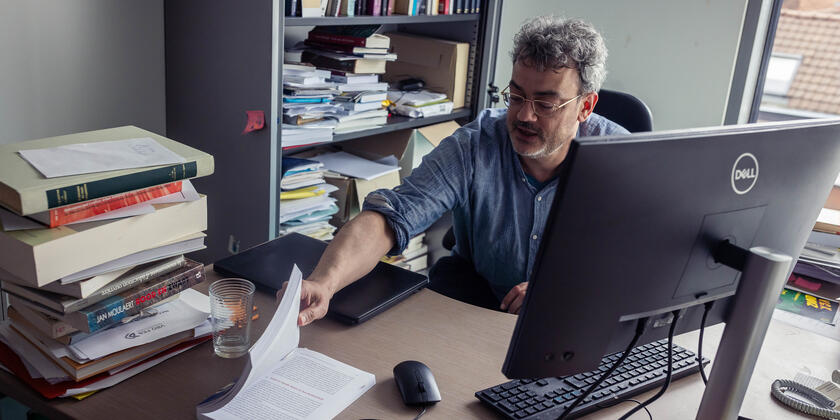
The conservator Kathleen Froyen has been working full-time on The Ghent Altarpiece since 2018. She coordinates the conservation studio at the Museum of Fine Arts and sits on many steering committees and advisory committees, but most of all, she enjoys getting behind the microscope herself to do some real work: the conservation of Van Eyck's magnum opus.